Sage vs QuickBooks UK 2026 — Which One Saves You More Money as You Grow?
Full Sage vs QuickBooks UK comparison for 2026. Pricing, payroll costs, MTD compliance, bank feeds, CIS, reporting, and real monthly cost tables for UK small businesses.
Ledger Businesses is reader-supported. When you buy through links on our site, we may earn an affiliate commission at no extra cost to you. Learn more.
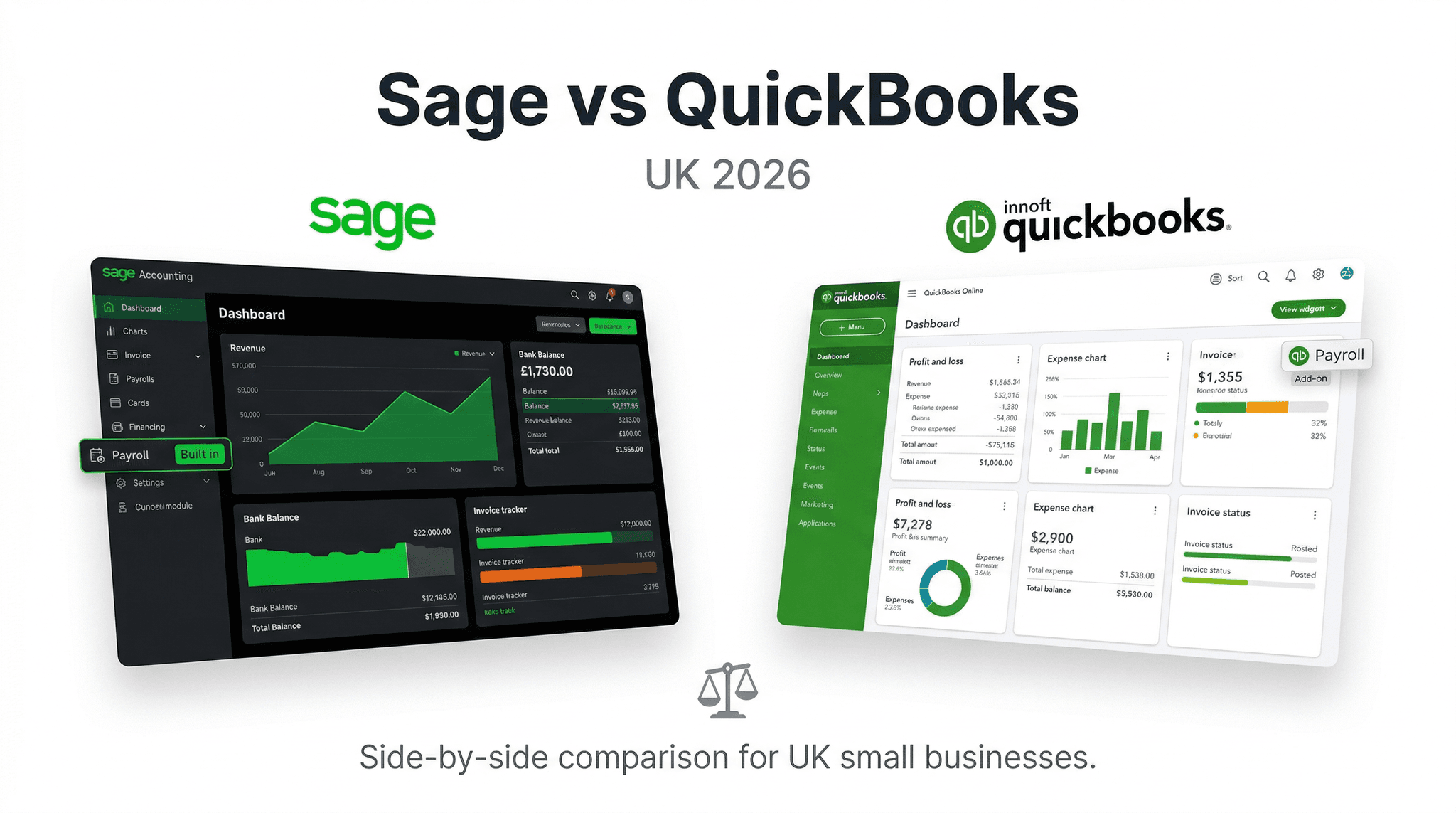
Sage and QuickBooks are both well-established in the UK small business accounting market, but they serve slightly different audiences and have different strengths. QuickBooks, developed by Intuit, has built its UK reputation on a polished, approachable interface and a strong feature set for sole traders and micro-businesses. Sage, with 40 years of UK heritage, has the edge in payroll depth, CIS handling, and phone support. This comparison examines every meaningful difference.
We treat this as a balanced analysis. QuickBooks wins on certain dimensions — particularly price at the entry level and reporting depth. Sage wins on payroll economics for employers and on UK-specific features like CIS. The right choice depends on your employee count, industry, and how you prioritise these trade-offs.
QuickBooks is cheaper for sole traders and micro-businesses without employees. Sage becomes the clear winner the moment you add even one employee, thanks to bundled payroll versus QuickBooks' £8/month base plus £2 per employee. For any construction business needing CIS, Sage is the only rational choice in this comparison. For businesses needing superior reporting depth, QuickBooks has the edge at equivalent price points.
Pricing: Plan-by-Plan Comparison
Both platforms use tiered monthly subscriptions. QuickBooks pricing is slightly lower at entry level, while Sage offers a broader top tier. Both companies regularly run promotional discounts — QuickBooks frequently offers 50% off for three months, while Sage's current promotion is 90% off for the first three to six months.
| Tier | Sage Plan | Sage Price/mo | QuickBooks Plan | QB Price/mo |
|---|---|---|---|---|
| Sole trader / entry | Accounting Start | £15 | Sole Trader | £10 |
| Basic accounting | Accounting Start | £15 | Simple Start | £16 |
| Core with payroll | Accounting Standard — £30 (payroll bundled) | £30 | Essentials + Payroll add-on | £33 + £8 + £2/employee |
| Advanced | Accounting Plus | £59 | Plus | £47 |
The headline comparison is nuanced. QuickBooks' Sole Trader plan at £10/month undercuts Sage for the smallest businesses with no accounting complexity. At the core accounting tier, both come in at similar headline prices, but Sage's Standard plan includes payroll while QuickBooks' Essentials does not. QuickBooks Plus at £47/month is cheaper than Sage Accounting Plus at £59/month for businesses needing advanced features, and includes stronger reporting functionality.
The Real Cost: Payroll Changes Everything
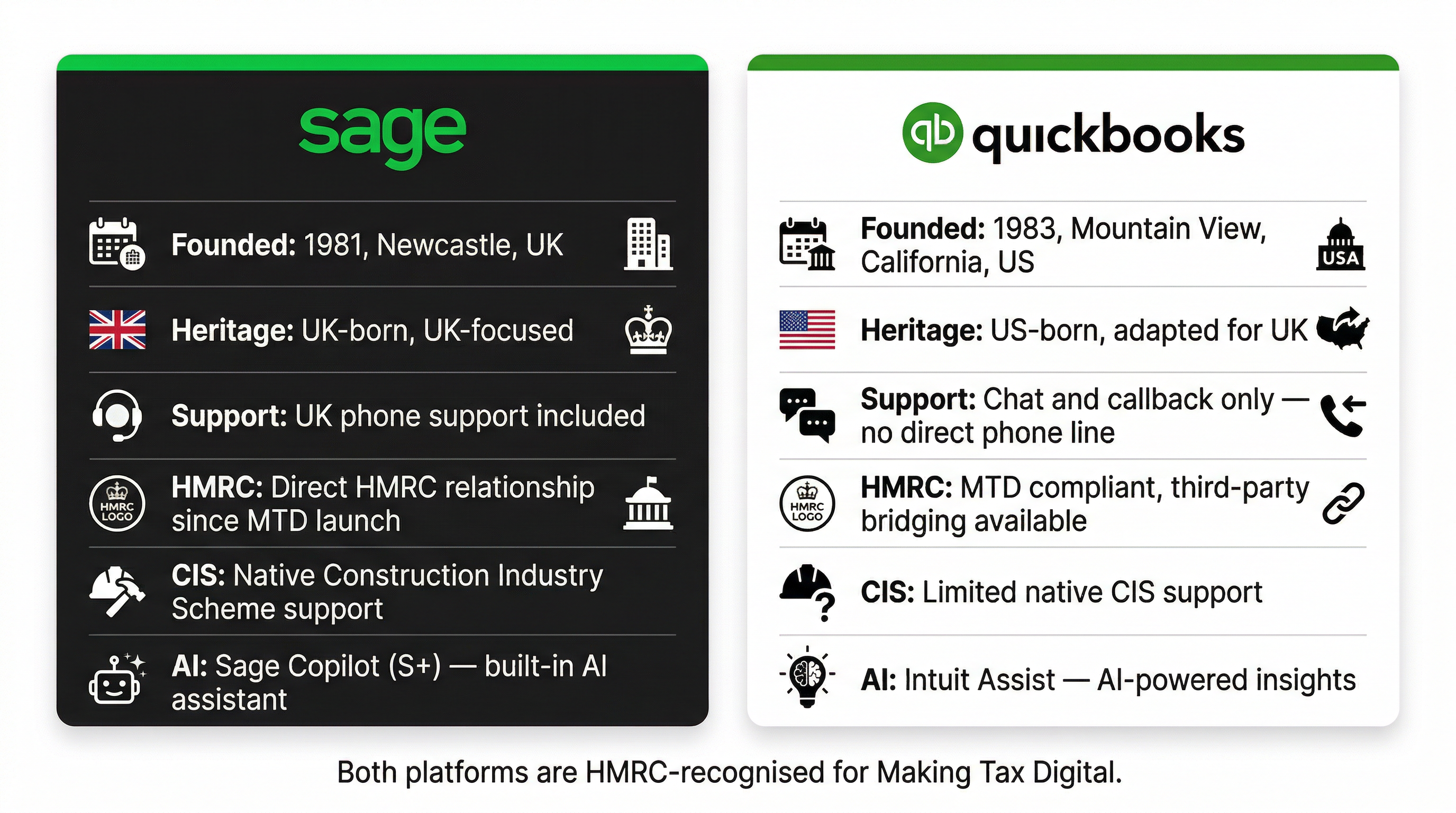
Like the Sage vs Xero comparison, the most important pricing dimension for any business with employees is the total cost including payroll. QuickBooks Payroll is priced at £8/month as a base fee, plus £2 per employee per month. This structure penalises growth and makes QuickBooks progressively more expensive as headcount rises.
| Business Size | Sage Standard (payroll bundled) | QB Essentials + Payroll | Monthly Saving with Sage |
|---|---|---|---|
| Sole trader (0 employees) | £30/mo | £33/mo (no payroll) | £3/mo (Sage cheaper) |
| 1 employee | £30/mo | £33 + £8 + £2 = £43/mo | £13/mo |
| 5 employees | £30/mo | £33 + £8 + £10 = £51/mo | £21/mo |
| 10 employees | £30/mo | £33 + £8 + £20 = £61/mo | £31/mo |
| 25 employees | £30/mo | £33 + £8 + £50 = £91/mo | £61/mo |
The savings are stark. A 10-employee business using Sage Standard saves £31/month — £372 per year — compared to equivalent QuickBooks functionality. At 25 employees, the annual saving is £732. These are not trivial sums for a small business. If you employ people, Sage's economics are simply better, and the gap widens with every new hire.
QuickBooks Payroll's £8/month base plus £2/employee structure means the cost rises with every hire. A 25-employee business pays £58/month for QuickBooks Payroll alone — before accounting software. Sage bundles payroll into the Standard plan at £30/month total. The more you grow, the more Sage saves.
Payroll: Feature Comparison
Cost aside, the payroll features themselves also differ meaningfully. Both platforms handle RTI filing, payslip generation, statutory payments (SSP, SMP, SPP, SAP), and auto-enrolment pension contributions. The differences emerge in depth and UK-specific features.
| Payroll Feature | Sage Payroll | QuickBooks Payroll |
|---|---|---|
| RTI filing with HMRC | Direct, automated | Yes |
| P60, P45, P11D | Full suite | P60 and P45; P11D limited |
| Auto-enrolment | NEST, NOW, People's Pension, Smart | NEST integration |
| CIS subcontractor payroll | Fully integrated | Via third-party add-on |
| Director payroll (alternative NI) | Yes | Yes |
| Employee portal (payslips, leave) | Yes | Basic |
| HMRC tax code management | Automated via PAYE tools | Manual in some cases |
Sage's payroll depth reflects its four decades of UK payroll heritage. The breadth of pension scheme integrations, the robust P11D handling, and the native CIS payroll give it a meaningful edge for most UK employers. QuickBooks Payroll covers the basics competently but lacks some of the depth that growing businesses need as their complexity increases.
MTD Compliance
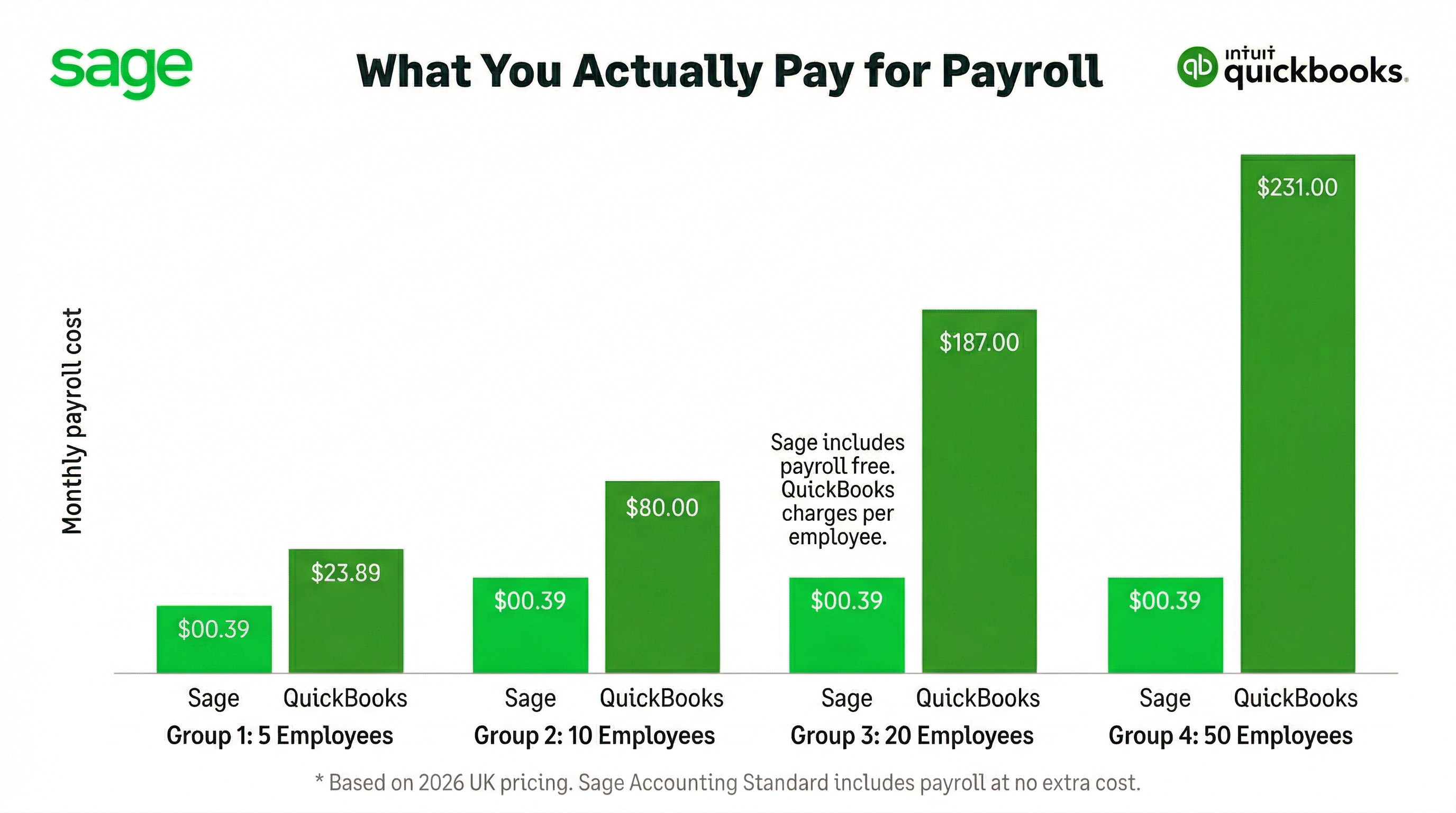
Both platforms are fully MTD for VAT compliant with direct HMRC submission, supporting all standard UK VAT schemes — standard rated, flat rate, cash accounting, and annual accounting. Both have development plans for MTD for Income Tax Self Assessment (ITSA) as it rolls out from April 2026 for unincorporated businesses.
Where Sage has an advantage is in the MTD AI Agent — part of Sage Copilot — which handles the MTD compliance workflow agentic ally, flagging issues and automating submissions rather than just facilitating them. QuickBooks' MTD implementation is solid and reliable but does not yet include equivalent agentic automation. For businesses with straightforward MTD requirements, the practical difference is small. For businesses managing quarterly MTD submissions across multiple businesses or complex VAT scenarios, Sage's AI-assisted approach reduces manual oversight.
Invoicing
Both platforms offer comprehensive invoicing — custom templates, automatic payment reminders, multiple payment methods, and direct integration with bank reconciliation. QuickBooks has a slight edge in invoice template flexibility, offering more customisation options for businesses that want their invoices to closely match their brand identity. QuickBooks also offers a slightly smoother quote-to-invoice workflow, particularly appreciated by businesses with complex pricing structures.
Sage's invoicing integrates tightly with its Copilot AI features — receipt matching and bank payment reconciliation happen more automatically on Sage's platform. Both are strong. This is not a decisive differentiator for most businesses.
Reporting: QuickBooks Has the Edge
QuickBooks has historically had a stronger reporting engine than Sage Accounting, and this remains true in 2026. QuickBooks' standard report library is broader — covering profitability, expenses, customers, VAT, balance sheet, and cash flow with more pre-built variants. Custom reporting is also more flexible in QuickBooks, with better column configuration, date range handling, and export options.
For business owners who rely heavily on financial reports to manage their business — tracking gross margin by product line, monitoring accounts receivable aging, or comparing performance across periods — QuickBooks' reporting engine is genuinely superior to Sage Accounting at equivalent plan levels. The gap is not enormous, and Sage has improved, but QuickBooks remains ahead on reporting depth and usability.
If your primary need is rich, flexible financial reporting, QuickBooks has the stronger engine within the SME accounting tier. Businesses that need dimensional reporting beyond QuickBooks' capabilities should consider Sage Intacct rather than choosing between these two products.
Bank Feeds and Reconciliation
Both platforms offer automated bank feeds via Open Banking connections to all major UK banks. QuickBooks' bank feed setup is slightly smoother in the initial configuration, with a more guided onboarding flow. Sage has improved its bank feed reliability significantly and now matches QuickBooks on connection stability with major banks.
Transaction matching — the automatic suggestion of categories for unreconciled bank transactions — is good on both platforms. QuickBooks has a slight edge in match accuracy based on user feedback, though the difference is marginal for most businesses. Both platforms learn from manual categorisations over time and improve matching accuracy accordingly.
CIS: Sage Wins Unambiguously
For UK construction businesses — whether contractors, subcontractors, or businesses with subcontractors on their books — CIS is non-negotiable. Sage includes full CIS functionality natively in the Standard plan: HMRC subcontractor verification, automatic CIS deduction calculation, CIS monthly returns (CIS300), and CIS-adjusted payslips. No third-party app required, no extra monthly fee.
QuickBooks handles CIS through third-party integrations. While these work, they add cost and complexity. For any UK construction business, Sage's native CIS is a decisive advantage that should settle the comparison immediately.
Mobile Apps
QuickBooks has consistently received higher mobile app ratings than Sage, with a more polished interface and broader functionality on mobile. The QuickBooks mobile app allows expense capture, invoice creation, time tracking, and financial reporting from a smartphone with a user experience that closely mirrors the desktop product.
Sage's mobile app has improved significantly but still feels slightly behind QuickBooks in mobile-first design. For business owners who manage most of their accounting from a phone rather than a desktop, QuickBooks offers a better mobile experience. Both cover the essential mobile use cases — creating invoices, capturing receipts, reviewing cash position.
Customer Support
Sage offers UK telephone support on all paid plans — a genuine differentiator. QuickBooks provides phone support only on certain plans and during limited hours, with chat and email as primary support channels. User reviews consistently cite QuickBooks' support response times as slower than Sage's during peak periods. For a business owner facing a critical issue at year-end or during a VAT return deadline, accessible phone support is valuable.
Which UK Businesses Should Choose Sage?
- Any business with employees — the payroll economics are compelling from the first hire
- Construction businesses and contractors needing native CIS handling
- Businesses that value UK phone support
- Businesses already using Sage 50 or planning to scale to Sage Intacct — staying in the ecosystem simplifies data migration
- Businesses where payroll features (pension auto-enrolment variety, P11D, CIS payroll) are complex
Which UK Businesses Should Choose QuickBooks?
- Sole traders and freelancers without employees — the £10/month Sole Trader plan is genuinely hard to beat for basic accounting needs
- Businesses that prioritise reporting depth and flexibility at the Plus tier (£47/month vs Sage Plus at £59/month)
- Businesses that primarily manage their accounting via mobile and want the best mobile experience
- Businesses that do not need CIS and have only a few employees where the payroll cost gap is smaller
- Businesses where the accountant or bookkeeper specifically recommends QuickBooks for their workflow
Our Verdict
QuickBooks Wins for Sole Traders
QuickBooks' £10/month Sole Trader plan is the most affordable proper accounting solution for UK sole traders with no employees. The reporting engine is strong, the mobile app is polished, and there is no reason to pay more for payroll features you do not use. For a freelancer or one-person business, QuickBooks is excellent value.
- Lowest price entry point for sole traders
- Best reporting depth at equivalent plan levels
- Better mobile app experience
- Competitive pricing at the advanced tier (£47 vs £59)
Sage Wins for Employers
Once you hire even one person, Sage's bundled payroll makes it consistently cheaper. At five employees, Sage saves £21/month versus QuickBooks with payroll. Add native CIS for construction businesses and UK phone support, and Sage is the clearer choice for any UK employer, particularly as the business grows.
- Payroll bundled — no per-employee charges
- Native CIS — no add-ons required
- UK phone support on all plans
- Deeper pension scheme integrations
Overall Assessment
The Sage vs QuickBooks decision is effectively a function of employee count and industry. For sole traders: QuickBooks' entry pricing and reporting depth give it the edge. For employers: Sage's bundled payroll creates clear savings that compound with growth. For construction: Sage's native CIS is decisive. Neither platform is universally better — the right answer depends entirely on your specific business profile, and either platform would serve most UK small businesses competently.