Sage Payroll vs Xero Payroll vs QuickBooks Payroll: UK Comparison 2026
A three-way payroll cost comparison that shows what UK businesses actually pay at different team sizes. Sage bundles payroll free with Accounting Standard (£30/mo flat), Xero charges £1-£1.50 per employee on top of its accounting plan, and QuickBooks charges £8/mo base plus £2/employee. At 20 employees, that's Sage at £30/mo vs QuickBooks at £86/mo — a £672/year difference. We also compare RTI filing, pension auto-enrolment, CIS support, statutory payments, and payslip delivery across all three.
Ledger Businesses is reader-supported. When you buy through links on our site, we may earn an affiliate commission at no extra cost to you. Learn more.
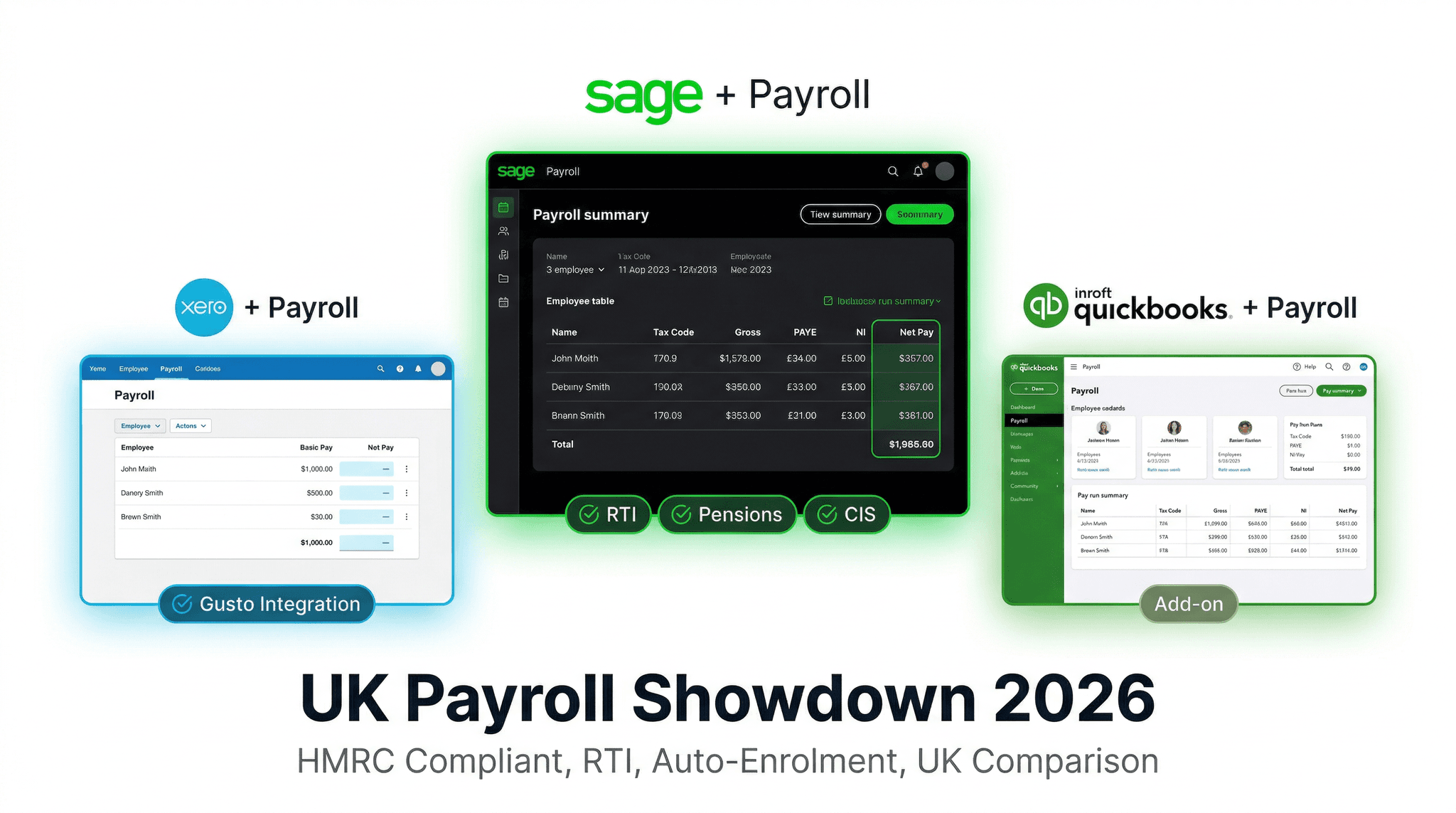
For most UK small businesses, payroll is not a standalone purchase — it is bundled with or added to an accounting software subscription. But the pricing models are very different between Sage, Xero, and QuickBooks, and those differences translate into real money as your headcount grows. This comparison examines all three payroll products on cost, features, compliance depth, and practical usability for UK employers.
One important framing: Sage payroll is bundled into the Sage Accounting Standard plan at no extra per-employee charge. Xero Payroll is a per-employee add-on to your Xero subscription. QuickBooks Payroll is an add-on with a monthly base fee plus a per-employee charge. The structural difference is significant and the cost implications compound with growth.
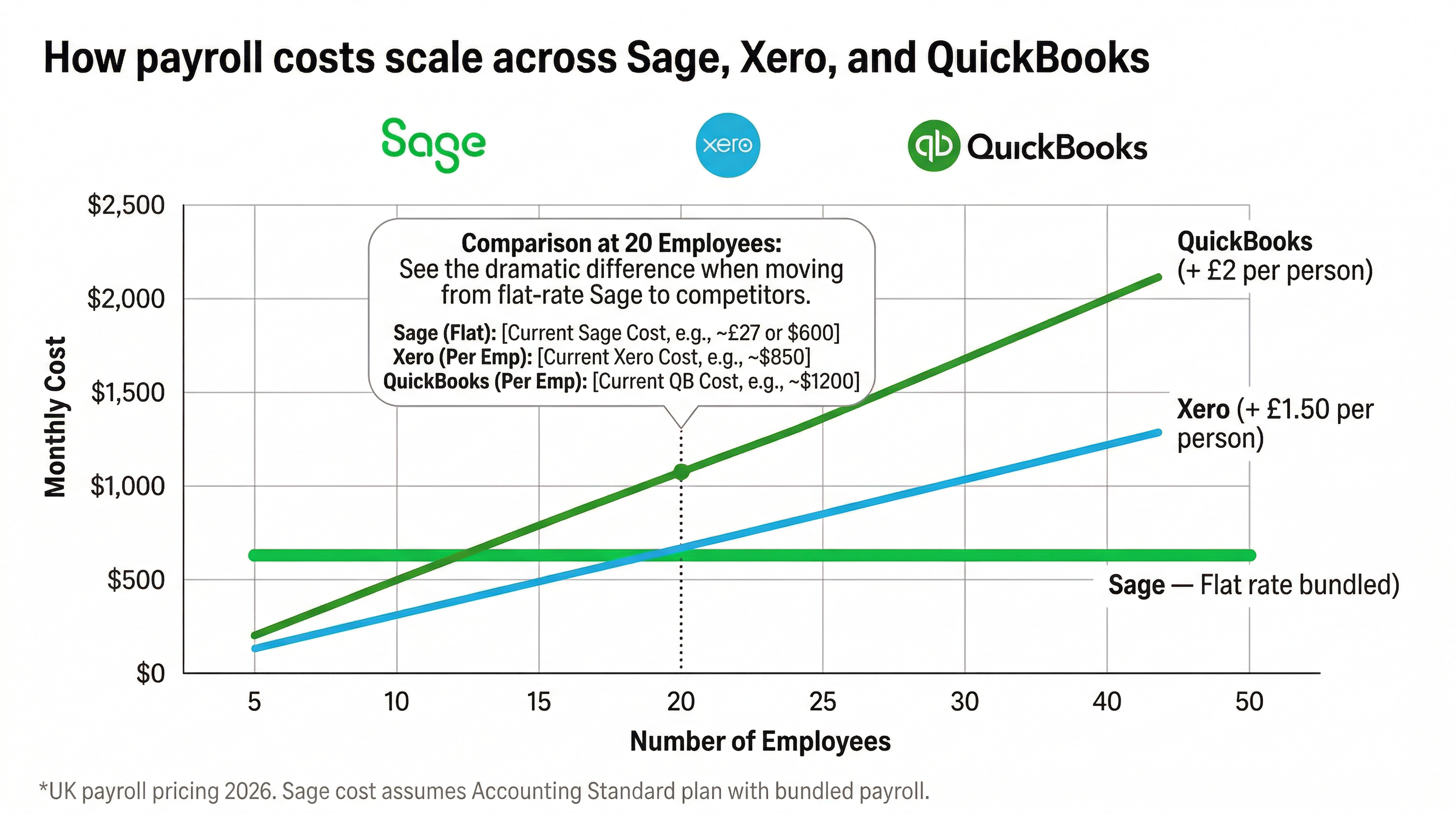
Sage bundles payroll into Accounting Standard (£30/month total, no per-employee fee). Xero charges approximately £1–£1.50 per employee per month on top of your accounting plan. QuickBooks charges £8/month as a base plus £2/employee. For any business with 5 or more employees, Sage's total cost including accounting is the lowest of the three.
Pricing Structure: How Each Platform Charges
Sage Payroll
Sage payroll is included at no additional charge with Sage Accounting Standard (£30/month). There is no per-employee fee, no cap on the number of employees you can run through the bundled payroll, and no tiered payroll pricing within the Accounting Standard plan. If you need standalone payroll (without the accounting suite), Sage offers three dedicated payroll plans: Payroll Essentials at £10/month (5 employees included, £2/extra), Payroll Standard at £20/month (5 employees included, £4/extra), and Payroll Premium at £30/month (5 employees included, £6/extra). However, for businesses that also need accounting software, the bundled approach in Accounting Standard is almost always the better value.
Xero Payroll
Xero Payroll is available as an add-on to any Xero accounting plan, priced per employee per month. The rate is approximately £1–£1.50 per employee depending on your plan. Xero's Comprehensive plan (£50/month) includes payroll for up to 10 employees as part of the bundle — beyond 10 employees, per-employee charges resume. The Ultimate plan (£65/month) includes payroll for up to 10 employees along with expenses and projects. For businesses with more than 10 employees on lower-tier plans, per-employee costs add up rapidly.
QuickBooks Payroll
QuickBooks Payroll is an add-on priced at £8/month as a base fee, plus £2/employee/month. This structure means that even a one-person payroll costs £10/month, and the cost rises linearly with every new hire. Unlike Sage and Xero, there is no plan that bundles payroll without per-employee charges (outside of the specific Ultimate Xero plan up to 10 employees). For growing businesses, QuickBooks' payroll pricing model is the most expensive of the three at scale.
Real Cost Comparison: Accounting + Payroll Combined
The most meaningful comparison is total monthly cost including both accounting and payroll. The table below shows the all-in monthly cost for a business using the mid-tier accounting plan from each provider with payroll included, at different employee counts.
| Employees | Sage Accounting Standard | Xero Grow + Payroll Add-on | QB Essentials + Payroll Add-on |
|---|---|---|---|
| 5 employees | £30/mo (all-in) | £37 + £7.50 = £44.50/mo | £33 + £8 + £10 = £51/mo |
| 10 employees | £30/mo (all-in) | £37 + £15 = £52/mo | £33 + £8 + £20 = £61/mo |
| 20 employees | £30/mo (all-in) | £37 + £30 = £67/mo | £33 + £8 + £40 = £81/mo |
| 50 employees | £30/mo (all-in) | £37 + £75 = £112/mo | £33 + £8 + £100 = £141/mo |
The data makes a compelling case. At 5 employees, Sage saves £14.50/month compared to Xero and £21/month compared to QuickBooks. At 50 employees, those savings are £82/month and £111/month respectively — representing annual savings of £984 versus Xero and £1,332 versus QuickBooks, for what is fundamentally the same accounting and payroll functionality. These are not trivial numbers for a small business.
A 50-employee business using Sage Accounting Standard saves approximately £984 per year versus the equivalent Xero setup and £1,332 per year versus the equivalent QuickBooks setup. The savings compound with every hire. For businesses planning to grow their headcount, Sage's cost structure becomes increasingly advantageous over time.
RTI Filing
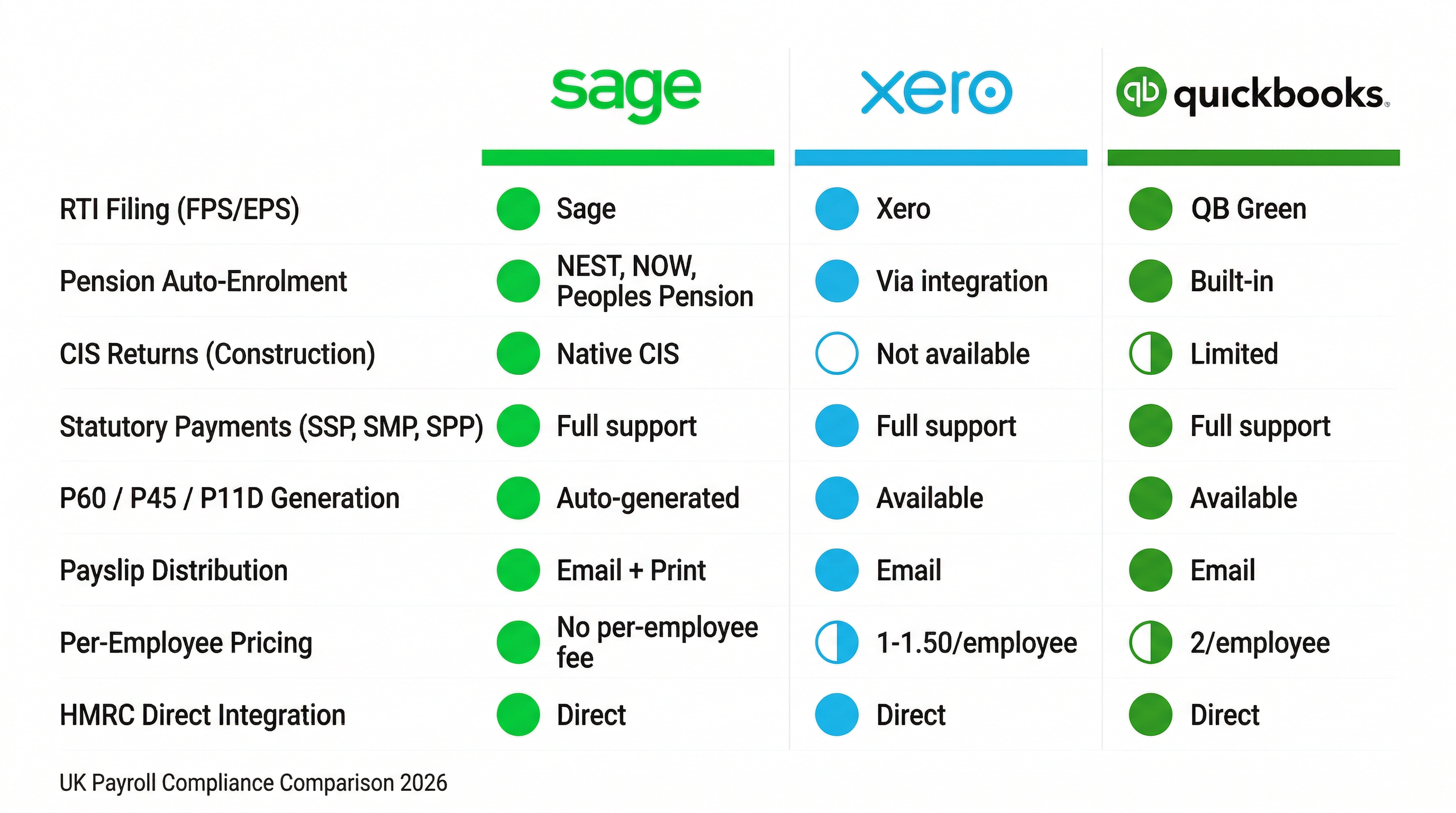
Real Time Information (RTI) reporting is the HMRC requirement for employers to submit payroll information to HMRC each time employees are paid. All three platforms handle RTI filing, but the implementation differs.
Sage's RTI filing is direct and automated — submissions are sent to HMRC as part of the payroll run, with confirmation received and logged within the platform. Sage has decades of RTI heritage (RTI was introduced in 2013 and Sage was one of the first platforms to implement it). The filing process is reliable and the error handling — flagging and resolving RTI errors before they become HMRC issues — is robust.
Xero's RTI filing is also direct and automated, integrated cleanly into the payroll run workflow. User experience for RTI on Xero is good, with clear submission confirmations and a straightforward interface for correcting submissions. QuickBooks RTI filing is similarly functional, with the standard submission and confirmation process that HMRC mandates.
All three platforms meet HMRC's RTI requirements competently. Sage's slight edge comes from the depth of its error-handling and its longer track record in this area. For businesses that have historically had RTI issues with other software, Sage's platform tends to produce fewer filing errors.
Auto-Enrolment Pension
Pension auto-enrolment is mandatory for all UK employers. All three platforms support auto-enrolment, but the breadth of supported pension providers and the automation of the enrolment process differs.
| Auto-Enrolment Feature | Sage Payroll | Xero Payroll | QuickBooks Payroll |
|---|---|---|---|
| Supported pension schemes | NEST, NOW, People's Pension, Smart, Aviva, Standard Life, Royal London, Legal & General | NEST, NOW, People's Pension, Smart | NEST (primary integration) |
| Direct pension file upload | Yes — automated contribution files | Yes — automated contribution files | Manual export to pension provider |
| Worker assessment automation | Automatic qualifying earnings assessment | Automatic assessment | Manual categorisation required |
| Re-enrolment reminders | Yes — scheduled three-year reminder | Manual | Not included |
| Opt-out management | Automated refund calculations | Manual | Manual |
Sage's auto-enrolment implementation is the most comprehensive of the three platforms, reflecting its status as the UK's largest payroll software provider. The breadth of supported pension schemes means that businesses with existing pension arrangements — not just those defaulting to NEST — can manage contributions directly from Sage without exporting files manually. The automated re-enrolment reminders and opt-out calculations represent features that are manual processes in both Xero and QuickBooks.
CIS (Construction Industry Scheme)
CIS is a mandatory HMRC scheme for contractors in the construction industry, requiring deductions from subcontractor payments and monthly CIS returns. The handling of CIS in payroll is a significant differentiator.
Sage includes full CIS functionality natively in Accounting Standard — subcontractor verification via HMRC, CIS deduction calculation (at standard 20% or higher risk 30% rates), CIS monthly returns (CIS300), and CIS-adjusted payslips. The CIS return is prepared and submitted directly from Sage without exporting to a third-party system.
Xero handles CIS through third-party integrations. It does have a built-in CIS feature, but it requires additional configuration and does not always handle the full CIS return workflow as seamlessly as Sage. Some users report needing a supplementary app for CIS300 filing. QuickBooks similarly relies on third-party apps or manual processes for CIS compliance. For any UK construction business, Sage's native CIS handling is a decisive advantage.
Statutory Payments
UK employers are required to administer a range of statutory payments through payroll: Statutory Sick Pay (SSP), Statutory Maternity Pay (SMP), Statutory Paternity Pay (SPP), Statutory Adoption Pay (SAP), and Shared Parental Pay (ShPP). All three platforms calculate these automatically — the rates are set by HMRC and updated annually.
| Statutory Payment | Sage | Xero | QuickBooks |
|---|---|---|---|
| SSP (Statutory Sick Pay) | Automatic calculation | Automatic calculation | Automatic calculation |
| SMP (Statutory Maternity Pay) | Full SMP schedule automation | Full SMP schedule | Basic SMP calculation |
| SPP (Statutory Paternity Pay) | Included | Included | Included |
| SAP (Statutory Adoption Pay) | Included | Included | Basic |
| ShPP (Shared Parental Pay) | Included | Limited | Manual calculation |
| NLW / NMW rate updates | Automatic annual updates | Automatic updates | Automatic updates |
All three platforms handle the most common statutory payments competently. Sage provides the most complete coverage of the full range, including Shared Parental Pay which Xero handles only partially and QuickBooks requires manual calculation for. For businesses with complex statutory payment scenarios — parental leave plans, multiple concurrent SSP employees — Sage's depth is valuable.
Payslips and Employee Self-Service
Payslip generation and distribution is table stakes for modern payroll software. All three platforms generate digital payslips automatically as part of the payroll run. The differences are in employee self-service and payslip delivery.
Sage provides an employee self-service portal where employees can access current and historical payslips, view P60s, and submit leave requests. The portal is accessible via web browser and mobile app. Xero offers a similar employee portal through Xero Me, which employees can access to view payslips and manage personal details. QuickBooks provides basic payslip delivery via email but its employee portal is less developed than either Sage or Xero.
Sage's payslip and P60 generation includes P11D handling for benefits in kind — expenses, company cars, private health insurance — which is more limited in both Xero and QuickBooks. For businesses with significant employee benefits, Sage's P11D module avoids the need for separate software or manual calculations.
Year-End and Tax Documents
Year-end payroll processing involves several HMRC-mandated submissions and documents. The quality of year-end support is a practical differentiator, particularly for businesses that process year-end without a payroll bureau.
| Year-End Feature | Sage | Xero | QuickBooks |
|---|---|---|---|
| P60 generation | Automatic — all employees | Automatic | Automatic |
| P45 on leaving | Automatic on employee exit | Automatic | Automatic |
| P11D (benefits in kind) | Full P11D generation and HMRC submission | Basic P11D support | Manual / limited |
| Final Full Payment Submission | Guided year-end process | Guided | Guided |
| Year-end checklist | Built-in guided checklist | Basic | Basic |
| HMRC payment schedule | Automated reminders | Manual tracking | Manual tracking |
Integration with Accounting
A critical practical consideration is how tightly payroll integrates with the accounting ledger. When payroll runs are posted to the accounting system automatically, it eliminates manual journal entries and reduces the risk of reconciliation errors. All three platforms offer native integration when using their own accounting software, but the depth of that integration differs.
Sage's payroll-to-accounting integration is the tightest of the three, reflecting the fact that both products are developed by the same team under the same codebase on the Standard plan. Payroll journal entries post automatically to the correct nominal accounts with correct coding for employer NI, employee deductions, pension contributions, and net pay. Reconciling the payroll balance sheet accounts is a near-automatic process.
Xero's payroll integration is also strong, with automatic journal posting and drill-through from accounting transactions to payroll runs. QuickBooks' payroll integration is functional but slightly less seamless in edge cases — complex leave scenarios or mid-period tax code changes occasionally require manual journal adjustments that are handled automatically in Sage.
Standalone Payroll vs Bundled Accounting
Not every business needs a new accounting platform — some already have an established accounting system and need payroll software to complement it. In this scenario, the comparison shifts to standalone payroll solutions, and Sage's dedicated payroll plans become relevant alongside specialist payroll providers like BrightPay (approximately £139+/year one-off licence) and IRIS Payroll (from £850+/year).
Sage's standalone payroll plans (Essentials £10/month, Standard £20/month, Premium £30/month) are competitively priced against BrightPay and IRIS for small and medium businesses, while offering the advantage of cloud access versus BrightPay's desktop-first model. For businesses that have outgrown their current payroll solution but are satisfied with their existing accounting software, Sage's standalone payroll is a strong option.
Who Should Choose Sage Payroll?
- Any business with 5 or more employees using cloud accounting — the cost advantage over Xero and QuickBooks grows with headcount
- Construction businesses that need native CIS payroll handling without third-party apps
- Businesses with a defined benefit or workplace pension scheme requiring automated contribution file upload beyond NEST
- Businesses that process P11D benefits in kind and want integrated submission rather than manual calculations
- Businesses that value comprehensive statutory payment support including Shared Parental Pay
- Employers who want automated re-enrolment reminders and opt-out management for pension compliance
Who Should Choose Xero Payroll?
- Businesses already committed to Xero accounting that value keeping everything in one platform
- Small businesses with fewer than 5 employees where the per-employee cost is manageable
- Businesses on the Xero Comprehensive or Ultimate plan where payroll is included for up to 10 employees — the bundled pricing is competitive at that specific tier
- Businesses whose accountant uses Xero Practice Manager and manages payroll on behalf of clients within the Xero ecosystem
Who Should Choose QuickBooks Payroll?
- Very small employers (1–2 employees) already using QuickBooks accounting, where the base fee plus minimal per-employee cost is affordable
- Sole-director limited companies processing a minimal salary where the payroll requirement is simple and infrequent
- Businesses where the accountant specifically recommends QuickBooks for their integrated workflow
Importantly, QuickBooks Payroll becomes progressively harder to justify on cost grounds as employee numbers grow. At 10+ employees, the £8 base plus £20 per-employee monthly cost of £28/month for payroll alone makes other options significantly more attractive.
Our Verdict
Sage Wins on Value for 5+ Employees
The numbers are unambiguous. At five employees, Sage's total accounting plus payroll cost is £30/month. Equivalent Xero is £44.50/month. Equivalent QuickBooks is £51/month. The gap widens with every hire. For any UK employer with five or more staff, Sage delivers the best value — and that value compounds as the business grows. The payroll features are also the most comprehensive of the three, with superior CIS support, broader pension integration, and more complete statutory payment handling.
- Lowest total cost at any employee count above one
- No per-employee charges — grows with you at no extra cost
- Most complete CIS payroll handling
- Broadest pension scheme integrations
- Full P11D and statutory payment suite
Xero Is Acceptable for Small Teams Already on Xero
If you are already using Xero and have a small team, switching solely for payroll savings may not be justified by the switching cost and disruption. Xero's payroll is fully functional and handles the standard UK payroll requirements competently. The Comprehensive plan's included payroll for up to 10 employees makes it more competitive at that specific tier. But for growing teams, the per-employee cost model will eventually make switching economics compelling.
QuickBooks Payroll Is Hard to Justify Beyond Small Teams
QuickBooks Payroll's fixed-plus-per-employee pricing structure is the most expensive of the three for any business beyond the smallest scale. A 10-employee business pays £28/month for QuickBooks Payroll alone — nearly as much as Sage's entire accounting-plus-payroll bundle. For businesses evaluating payroll options from scratch, QuickBooks Payroll is difficult to recommend over Sage or even Xero on a pure cost basis, particularly for growing businesses.
Overall Winner: Sage — by a Significant Margin for Most UK Employers
Sage Payroll, bundled within Sage Accounting Standard at £30/month, represents the best overall value for UK employers of virtually any size. The combination of zero per-employee charges, the broadest feature set (CIS, P11D, pension provider breadth, statutory payments), and 40 years of UK payroll heritage makes it the rational choice for employers planning to grow. The annual savings versus Xero and QuickBooks are real and material — and they accrue year after year. For a business with 20 employees, choosing Sage over QuickBooks saves over £600 per year. That is money that belongs in your business, not your software subscriptions.