How to Choose Accounting Software for Your UK E-Commerce Business.
A practical guide for UK e-commerce businesses that need accounting software handling multi-currency transactions, inventory management, marketplace integrations, and VAT on international sales. Sage Accounting Plus (£59/mo) covers multi-currency invoicing, stock tracking and budgets. We compare it with Xero (excellent Shopify integration), QuickBooks (strong reporting), and specialist options. Also covers payment gateway reconciliation, Amazon and eBay seller accounting, VAT OSS for EU sales, and fulfilment cost tracking.
Ledger Businesses is reader-supported. When you buy through links on our site, we may earn an affiliate commission at no extra cost to you. Learn more.
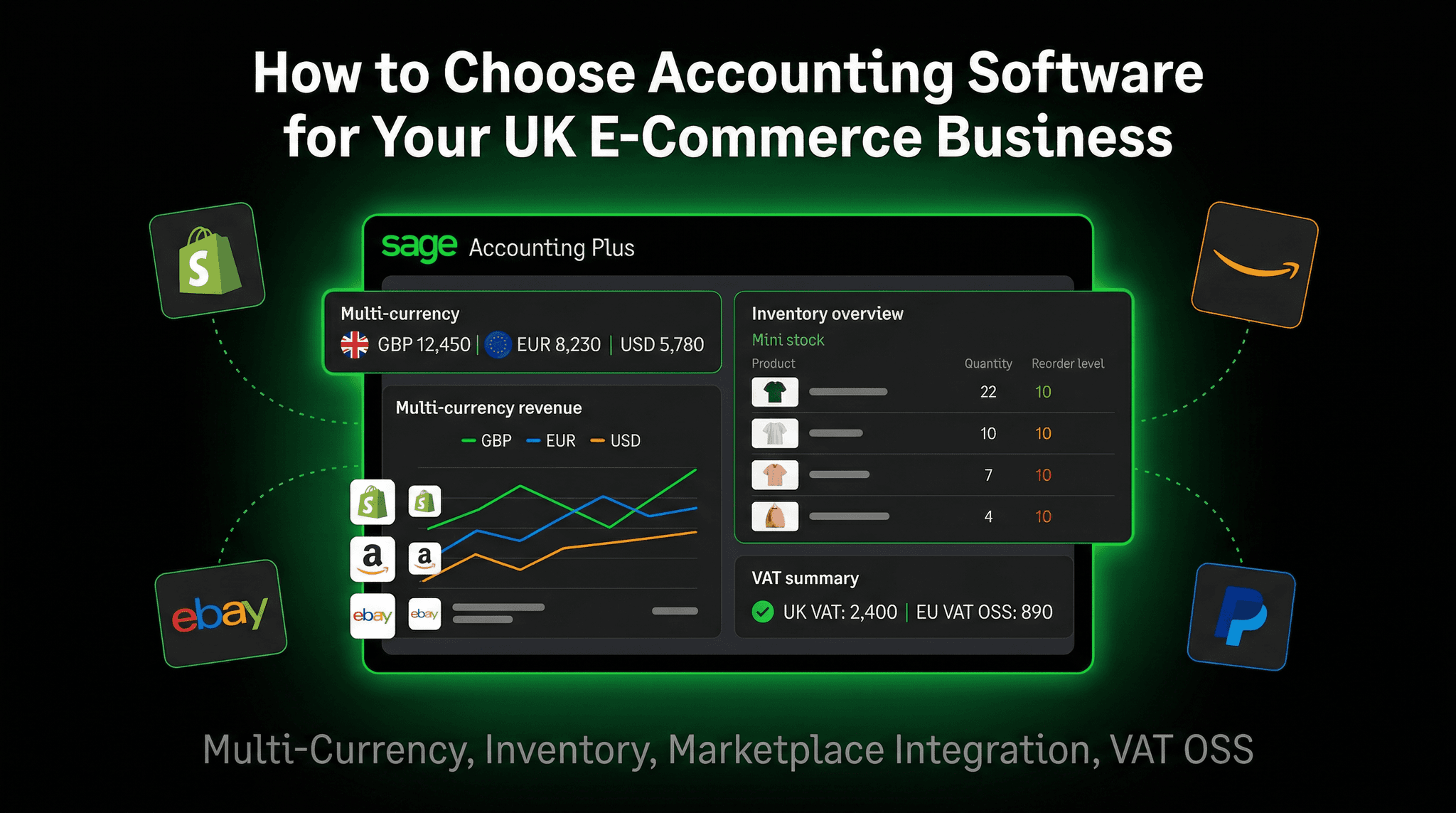
Accounting for an e-commerce business is materially different from accounting for a service business. A consultant receives a bank transfer and issues an invoice — the accounting is clean. An e-commerce seller receives daily or weekly settlements from Amazon or PayPal that bundle together dozens of individual sales, refunds, platform fees, and VAT components in a single net figure. Reconciling that settlement to your accounting records, tracking inventory costs against sales revenues, and handling VAT across multiple countries simultaneously creates a complexity that many standard accounting tools were not designed to manage.
This guide examines the specific accounting challenges that UK e-commerce businesses face in 2026, and compares how Sage Accounting Plus, Xero, and QuickBooks handle each of them. We also cover the integrations and ancillary tools that close the gaps where the core platforms fall short.
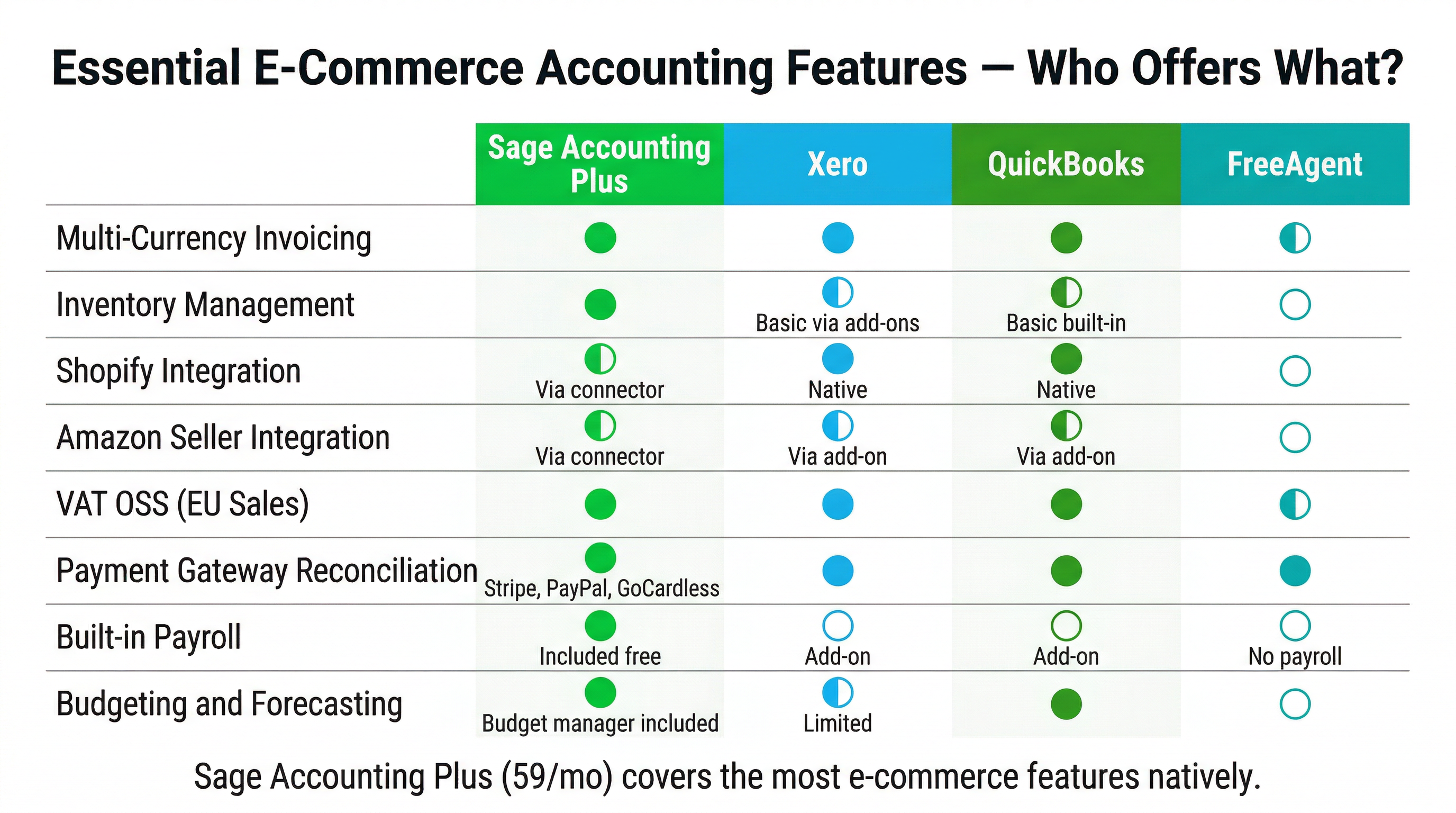
For a UK e-commerce business selling across multiple countries, you need accounting software with native multi-currency support, inventory management, and integration with your marketplaces and payment gateways. Sage Accounting Plus (£59/mo) handles all three natively. Xero requires apps for inventory and has better native Shopify integration. QuickBooks Plus is strong on reporting but weaker on multi-currency.
The Specific Accounting Challenges of UK E-Commerce
Marketplace Settlement Reconciliation
The single most common accounting headache for UK e-commerce sellers is reconciling marketplace settlements. When Amazon pays you weekly or bi-weekly, the settlement figure is a net amount after Amazon has deducted its fees, refunded customers on your behalf, and collected VAT where it acts as the marketplace. The settlement does not neatly correspond to any individual sale or invoice.
To reconcile correctly, you need to:
- Record gross sales revenue (the price customers paid)
- Record Amazon's fees as an expense
- Record customer refunds as a reduction in revenue
- Account for VAT collected by Amazon under marketplace facilitator rules
- Match the net settlement to your bank receipt
If you simply record the net settlement as income, your revenue figures will be understated, your fee expenses will be missing, and your VAT position will be incorrect. This is not merely a bookkeeping tidiness issue — it affects your VAT return, your profit and loss statement, and ultimately your tax liability.
Multi-Currency Sales
UK e-commerce businesses that sell to customers in the EU, the US, or elsewhere receive income in multiple currencies. A UK seller on Amazon might have UK, Germany, France, and the US as separate storefronts, each paying out in a different currency. Your accounting software needs to:
- Record transactions in the original currency
- Convert to GBP at the correct exchange rate for accounting purposes
- Recognise foreign exchange gains or losses when the exchange rate differs between the transaction date and settlement date
- Report totals in GBP for VAT returns, management accounts, and tax purposes
Inventory and Cost of Goods Sold
Product-based businesses need to track inventory — both the quantity of goods on hand and their cost. The accounting for inventory is more complex than for services: when you buy stock, the cost sits on your balance sheet as an asset (not immediately as an expense). When you sell the product, the cost moves from the balance sheet to the profit and loss account as "cost of goods sold." This distinction is fundamental to calculating your gross profit correctly.
For e-commerce businesses with large product ranges, multiple storage locations, or fulfilment by marketplaces (FBA), accurate inventory accounting requires either dedicated inventory management software or a core accounting platform with strong native inventory support.
VAT for International Sales
Post-Brexit, UK e-commerce businesses selling to EU consumers face significant VAT complexity. The EU's One Stop Shop (OSS) scheme allows UK sellers who register for it to account for all EU VAT through a single registration in one EU member state, rather than registering in every country where they have customers. However, this requires tracking sales by EU country and applying the correct local VAT rate for each.
For digital products and services sold to EU consumers, the rules are slightly different — UK sellers may need to account for VAT in the customer's country regardless of the sales value. And for goods imported into the EU with a value over €150, VAT must be collected at point of sale under the Import One Stop Shop (IOSS) scheme.
Managing all of this within your accounting software — or via an integration that feeds data into it — is essential for UK sellers with EU ambitions.
Sage Accounting Plus for E-Commerce
Sage Accounting Plus, priced at £59 per month (plus VAT, with a current promotional offer of 90% off for the first three to six months), is Sage's most comprehensive SMB accounting product. It includes features specifically relevant to e-commerce businesses that are absent from the Standard and Start plans:
Multi-Currency Invoicing and Reporting
Sage Accounting Plus supports multi-currency invoicing natively. You can raise invoices in any major currency, with Sage automatically applying the current exchange rate and recording the GBP equivalent. When payment arrives, Sage calculates the exchange gain or loss based on the rate at payment date versus the rate at invoice date. All management reports can be viewed in GBP or in the original transaction currency.
For a UK seller with an Amazon US storefront, this means dollar-denominated revenues are correctly converted and any currency fluctuation between order and settlement is captured as a finance gain or loss — exactly as your accountant would require.
Inventory Management
Sage Accounting Plus includes native inventory management. You can create product records with cost prices, set up stock locations, record goods received into stock, and have Sage automatically post the cost of goods sold when you raise a sales invoice. The inventory report shows current stock levels and valuations, and Sage can alert you when stock falls below a reorder point.
This native inventory support means that for many UK e-commerce businesses with a moderate number of SKUs, Sage Plus eliminates the need for a separate inventory system. The accounting and inventory data live in the same place, which reduces reconciliation errors and simplifies year-end stock count procedures.
Budget and Forecasting Tools
Sage Accounting Plus adds budget functionality — you can set monthly or annual budgets by income and expense category and compare actuals against budget in real time. For a growing e-commerce business managing advertising spend, cost of goods, and fulfilment costs, budget tracking by category is essential for understanding whether your margin assumptions are holding up as volume increases.
Marketplace Integration via Connectors
Sage connects to major e-commerce marketplaces and payment gateways through the Sage Marketplace and third-party integration tools. A2X — one of the most widely used e-commerce accounting connectors — integrates with Sage to handle Amazon and Shopify settlement reconciliation. A2X maps each settlement component (sales, fees, refunds, VAT) to the correct accounting category in Sage, eliminating the manual reconciliation that otherwise consumes hours each week.
Direct connections available for Sage include Shopify (via official integration), Stripe, GoCardless, and PayPal. These allow payment gateway data to flow automatically into Sage, matching against bank transactions for reconciliation.
Xero for E-Commerce
Xero has built a strong reputation in the e-commerce sector, largely on the strength of its Shopify integration. The native Xero-Shopify connection is one of the most mature in the market — it automatically imports Shopify orders, payments, refunds, and fees into Xero with correctly mapped accounting categories, and handles multi-currency Shopify transactions appropriately.
Xero's Strengths for E-Commerce
- Shopify integration: Widely regarded as the best available for a cloud accounting platform. Handles daily sales summaries, refunds, fees, and payment gateway payouts.
- App ecosystem: A2X (Amazon reconciliation), Cin7 (inventory), DEAR Systems (inventory and order management), Unleashed (inventory), and many others integrate well with Xero.
- Multi-currency: Included on the Grow plan (£37/month) and above. Handles foreign currency invoices, automatic revaluation, and exchange gain/loss reporting.
- Stripe integration: Real-time Stripe payment data flows into Xero via the official integration, making payment reconciliation straightforward.
Xero's Limitations for E-Commerce
- No native inventory: Xero does not include inventory management. You need a third-party app (Cin7, Unleashed, DEAR) which adds monthly cost and integration complexity.
- Amazon integration: No native Amazon connection — requires A2X or a similar tool (approximately £19-49 per month depending on order volume).
- Total cost: Once you add inventory management (£30-60/mo) and Amazon reconciliation (£19-49/mo) to a Xero Grow subscription (£37/mo), the total monthly cost can reach £85-146 per month before VAT.
QuickBooks for E-Commerce
QuickBooks Plus at £47 per month includes inventory tracking — a feature that requires an add-on in Xero. The inventory functionality in QuickBooks uses a first-in, first-out (FIFO) costing method and tracks quantity and value of stock in real time as you create sales invoices and purchase orders. For e-commerce businesses with a focused product range, this built-in inventory may eliminate the need for a separate system.
QuickBooks' Strengths for E-Commerce
- Inventory included in Plus plan: No additional app needed for basic stock management, reducing total monthly cost.
- Strong reporting: QuickBooks' custom report builder is one of the best in the SMB market. Product profitability reports, sales by item, and inventory valuation reports are all available without customisation.
- E-commerce integrations: Shopify, Amazon (via A2X), eBay, Etsy, and WooCommerce all connect to QuickBooks through official or well-maintained third-party integrations.
QuickBooks' Limitations for E-Commerce
- Multi-currency: Available only on the Plus plan and above, and some limitations apply — you cannot use multicurrency with certain features including budgets and certain reports.
- Payroll add-on cost: If you have employees, payroll costs extra at £8 per month plus £2 per employee — meaningful for a business already paying for the Plus plan.
- EU VAT OSS reporting: QuickBooks does not have native OSS reporting. You need to extract the data and use a separate tool or accountant process to file OSS returns.
International VAT: OSS, IOSS, and What Your Software Needs to Handle
The One Stop Shop (OSS) for Goods
UK sellers selling goods to EU consumers must register for VAT in each EU country where they sell if their sales exceed that country's registration threshold — unless they use the Union OSS scheme. The Union OSS allows EU-established sellers to account for all EU VAT through a single registration. UK sellers are not directly eligible for the Union OSS but may access it via an EU-based fulfilment centre or by registering a company in an EU member state.
Your accounting software needs to track sales by EU country and apply the correct local VAT rate. Sage Accounting Plus's multi-currency and multi-tax rate support can be configured for this, though you may need to set up EU VAT rates manually. Xero handles multiple tax rates well and has EU VAT report functionality. QuickBooks similarly supports custom tax rates per country.
The Import One Stop Shop (IOSS)
For goods dispatched from outside the EU with a value of €150 or less, UK sellers can register for IOSS and charge VAT at point of sale, remitting it monthly to the EU via a single return. Without IOSS, the customer pays VAT and customs duties on import — a poor customer experience that drives abandoned purchases.
None of the accounting platforms covered here have native IOSS return filing — this is typically handled by a VAT compliance specialist or a dedicated IOSS service. Your accounting software provides the sales data by country that your IOSS filer needs; the actual return is submitted separately.
Fulfillment by Amazon (FBA) VAT Implications
UK sellers using FBA to store inventory in European Amazon fulfilment centres may create a VAT nexus in those countries — requiring local VAT registration even before reaching the distance selling thresholds. Amazon's own VAT Services programme can manage this, generating local VAT returns from your sales data. Your accounting software then needs to record the VAT due in each country as a liability, separate from your UK VAT.
| Feature | Sage Accounting Plus (£59/mo) | Xero Grow + apps | QuickBooks Plus (£47/mo) |
|---|---|---|---|
| Multi-currency | Native — included | Native (Grow+) | Yes (some limitations) |
| Inventory management | Native — included | Via third-party app (extra cost) | Native (Plus plan) |
| Shopify integration | Official integration | Best-in-class native | Official integration |
| Amazon reconciliation | Via A2X connector | Via A2X connector | Via A2X connector |
| eBay integration | Via third-party | Via third-party | Via third-party |
| Payment gateway (Stripe/PayPal) | Native connections | Strong native connections | Strong native connections |
| EU VAT rate support | Multi-rate configurable | Multi-rate configurable | Multi-rate (manual setup) |
| Budgets | Included | Analytics Plus add-on | Included (Plus) |
| Unlimited users | Included | 3 users on Grow | 5 users on Plus |
| Effective monthly all-in cost | ~£59-78/mo with A2X | ~£85-120/mo with apps | ~£66-96/mo with A2X |
Payment Gateway Reconciliation: The Practical Reality
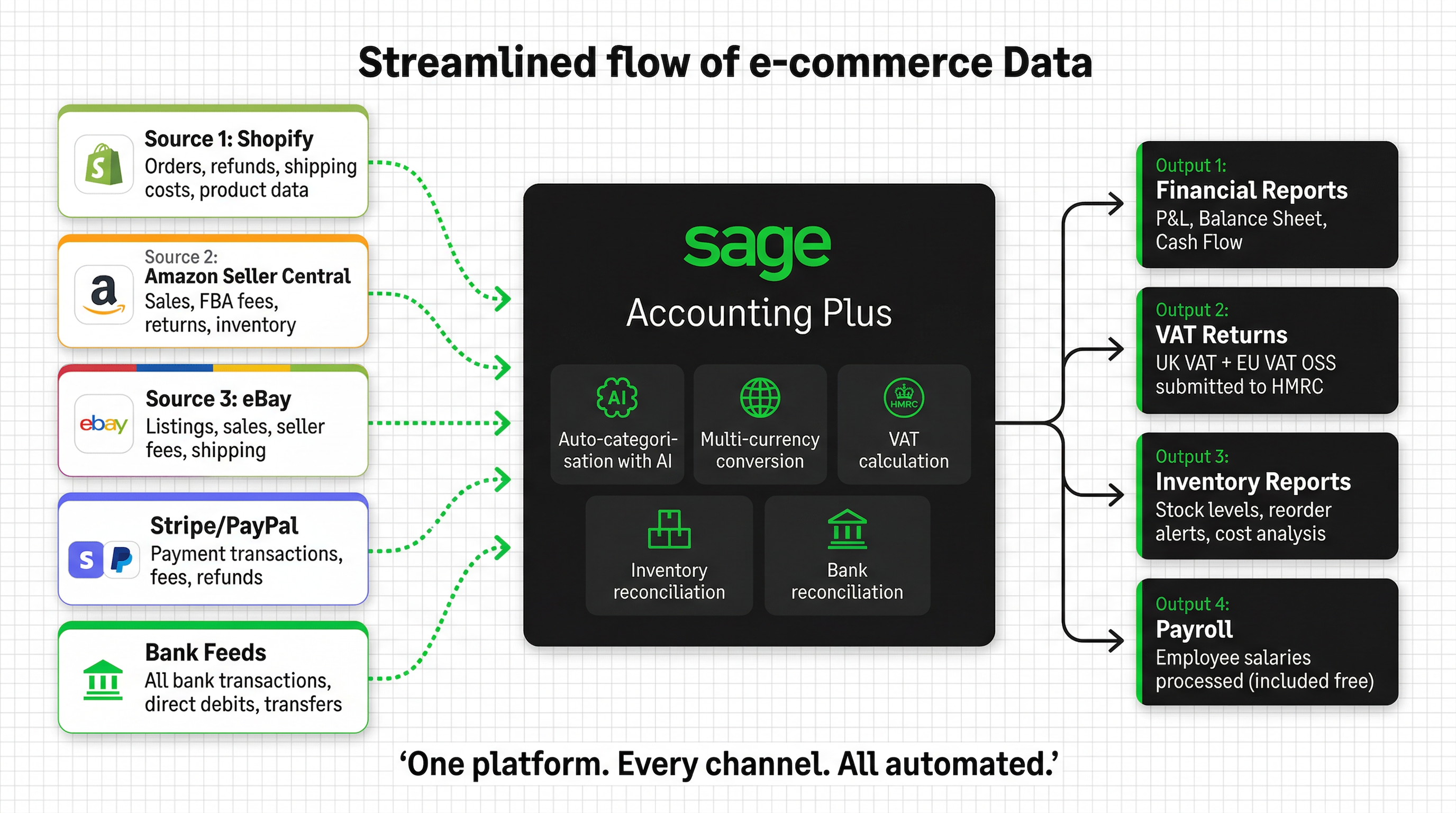
Payment gateways — Stripe, PayPal, Klarna, Square, SumUp — all pay out net amounts to your bank account, having deducted transaction fees and (in PayPal's case) sometimes holding funds in your PayPal balance for days or weeks before transferring. Reconciling your bank statements to your sales records requires matching three layers of data:
- Individual sales transactions (what customers paid, including VAT)
- Payment processor transactions (what the gateway received, before fees)
- Bank transactions (what actually landed in your account, net of fees)
Stripe's native integration with both Sage and Xero is the gold standard here — real-time transaction data flows into the accounting software with fees already separated. PayPal's integration is less clean in all platforms; many e-commerce accountants recommend configuring PayPal as a separate "bank account" within your accounting software and reconciling the PayPal balance independently before reconciling the PayPal-to-bank transfers.
Stock Tracking for E-Commerce: What You Actually Need
The right stock tracking setup depends on your volume and complexity. Consider these scenarios:
Fewer than 50 SKUs, Single Warehouse
Native inventory in Sage Plus or QuickBooks Plus is likely sufficient. Set up product records with cost prices, record purchase orders when you buy stock, and let the system track quantity and value. Run a stock count quarterly to reconcile physical stock against the software records.
50-500 SKUs, Multi-Channel (Shopify + Amazon + eBay)
At this scale, you need an inventory management system that sits above your accounting software and feeds sales and stock movement data down to it. Tools like Linnworks, Brightpearl, or Cin7 centralise orders from all channels, update stock levels in real time, and push settlement summaries to Xero or Sage. The accounting software receives clean, summarised data rather than individual transaction feeds.
FBA and Third-Party Fulfilment
If Amazon holds stock on your behalf in its fulfilment centres, or you use a third-party logistics provider, your stock is in locations you do not physically control. Tracking FBA inventory requires Amazon's inventory reports, which A2X can help map to your accounting software. For multiple fulfilment locations, a dedicated inventory tool is almost always necessary.
Choosing the Right Setup for Your E-Commerce Stage
Early Stage: Low Volume, UK Only
Start with Sage Accounting Start (£15-18/month) or Xero Ignite (£16/month). Connect your Shopify store or Stripe account directly. Use bank feeds for other payment gateways. At this stage, native multi-currency and inventory are not yet essential, and the lower plan cost preserves cash while you test your business model.
Growing: Multi-Channel, Starting to Export
Upgrade to Sage Accounting Plus (£59/month) or Xero Grow (£37/month) plus inventory app. Add A2X if you are selling on Amazon (approximately £19-49/month depending on order volume). At this point, multi-currency becomes important if you are trading in EUR, USD, or other currencies, and inventory tracking becomes essential for accurate margin reporting.
Established: Multi-Country, Complex VAT, Team
Sage Accounting Plus with A2X and potentially a VAT compliance service for EU OSS/IOSS. The unlimited user seats in Sage Plus mean your operations team can raise purchase orders, your accountant can access reports, and your finance manager can review the accounts — all without additional user seat costs. For very high volume operations, consider Sage Intacct which adds multi-entity consolidation (useful if you have separate legal entities in different countries) and advanced dimensional reporting.
Our Verdict
Best All-In-One for UK E-Commerce: Sage Accounting Plus
For a UK e-commerce business that sells across multiple channels, ships internationally, and needs inventory management without paying for a separate system, Sage Accounting Plus delivers more native functionality per pound than any competitor at its price point. Multi-currency, inventory, unlimited users, and native UK bank feeds are all included.
- Multi-currency and inventory both included — no extra apps needed for core functions
- Unlimited users — no per-seat premium as your team grows
- Sage Copilot AI for categorisation and cash flow insights
- Clear upgrade path to Sage Intacct for multi-entity operations
- UK phone support — valuable at VAT return time
Best for Shopify-First Businesses: Xero
If Shopify is your primary sales channel and you want the cleanest possible Shopify accounting integration, Xero's native Shopify connection is the market leader. Accept the need for an inventory add-on and the slightly higher all-in cost, and Xero delivers excellent multi-currency reporting and a very clean user experience.
- Best-in-class Shopify integration — fewer reconciliation issues
- Mature Stripe and GoCardless connections
- Excellent multi-currency revaluation and reporting
- Budget via Xero Analytics Plus (extra cost)
Best for Reporting and Analytics: QuickBooks Plus
If in-depth profitability reporting is your priority — particularly product margin analysis and customer segment reporting — QuickBooks Plus has the most flexible custom reporting suite at its price point. Native inventory and strong reporting make it a credible choice for UK e-commerce businesses that are data-driven.
- Native inventory tracking included at the Plus price
- Custom report builder — best flexibility of any platform compared
- Strong profitability by product and by channel reporting
- Lower list price than Sage Plus before app additions
Whichever platform you choose, the key principle for e-commerce accounting is to configure it correctly at the outset rather than accumulating errors that need untangling later. The marketplace settlement reconciliation, inventory cost matching, and international VAT calculations that make e-commerce accounting complex all become manageable — even for a non-accountant founder — when the software and integrations are set up correctly from the start.