Startup Accounting Software UK 2026 — 7 Platforms Compared from Free to Enterprise
Comparing the best accounting software for UK startups in 2026. From free tools at launch through to scalable platforms — covering Sage, Xero, QuickBooks, FreeAgent, Wave, and Zoho Books.
Ledger Businesses is reader-supported. When you buy through links on our site, we may earn an affiliate commission at no extra cost to you. Learn more.
Choosing accounting software is one of those decisions that feels low-stakes when you are just starting out — and becomes increasingly consequential as your business grows. The founders who pick the right platform from the start spend their time on product and customers. Those who pick the wrong one spend six months migrating data, re-training their team, and wrestling with limitations at precisely the point where they have the least time to spare.
UK startups face a particular set of accounting requirements: Making Tax Digital compliance from day one, HMRC's increasingly digital interactions, potential R&D tax credit claims if you are in tech, the need to report to Companies House from the first year end, and — for the ambitious ones — the need for a system that can handle investor reporting, multi-currency, and eventually group consolidation without a full rebuild.
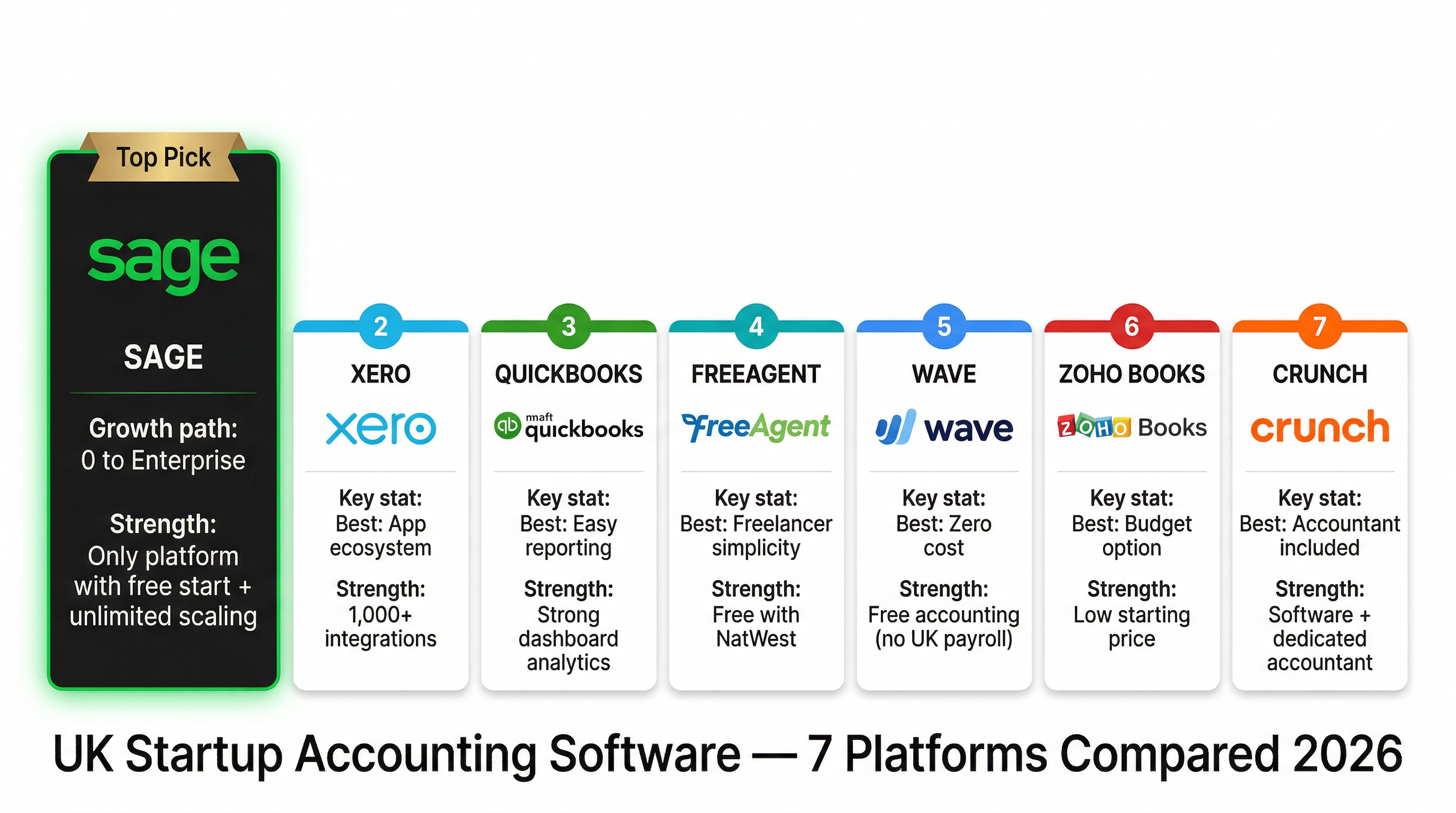
This guide compares seven platforms across the metrics that matter most to early-stage and scaling UK businesses. We have been deliberately honest about the weaknesses of each, including Sage — because the right choice for a three-person fintech seed round is different from the right choice for a sole trader consultancy growing into a small limited company.
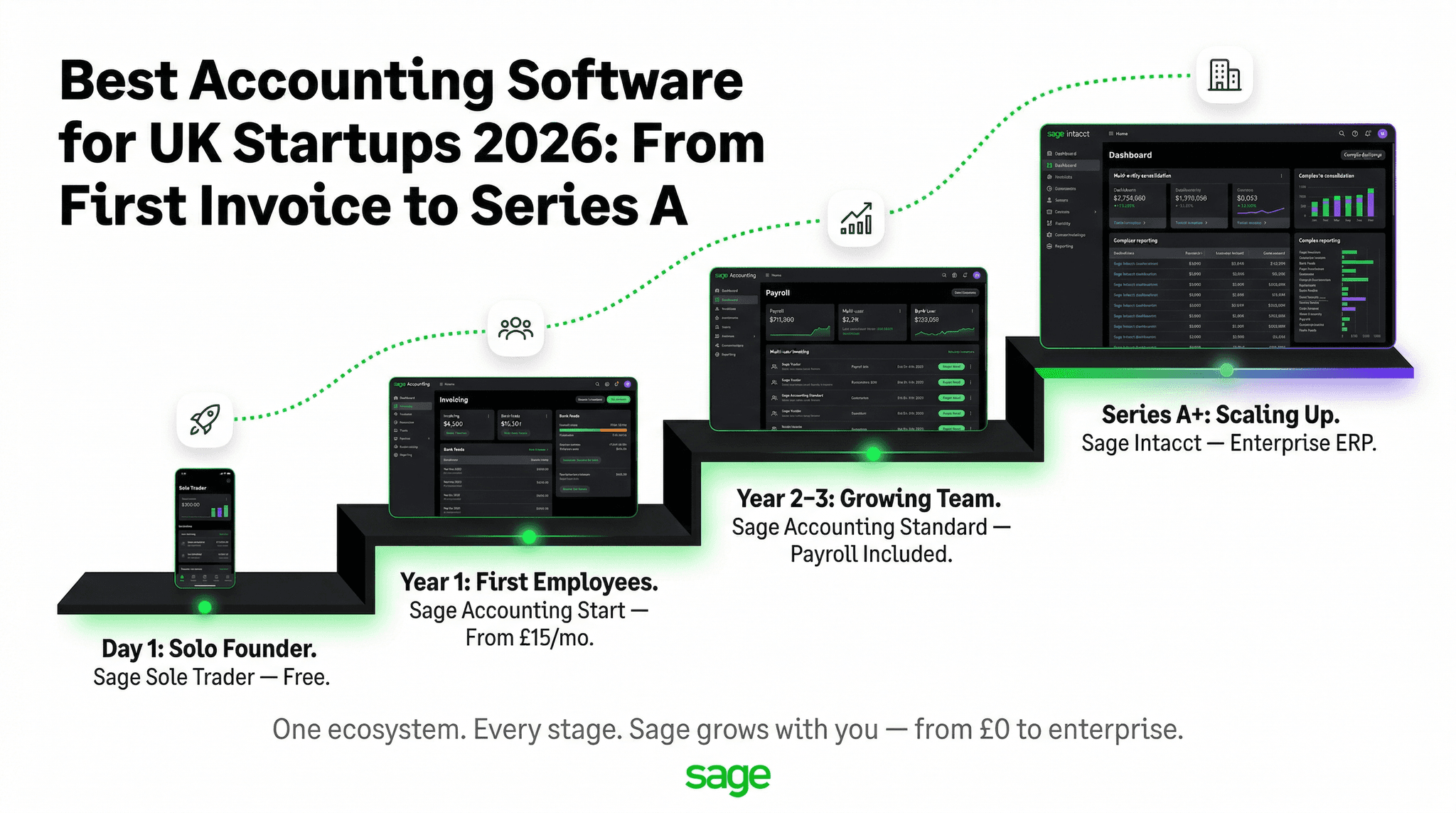
Sage offers the clearest upgrade path of any UK accounting platform: start free on Sage Sole Trader, move to Accounting Start (£15-18/mo), upgrade to Standard (£30-39/mo) as you add employees, then to Plus (£59/mo) for multi-currency and inventory, and eventually to Intacct for enterprise-grade financial management. No data migration required between Sage products.
What UK Startups Actually Need from Accounting Software
Before comparing products, it is worth being precise about what "startup accounting" actually requires. The needs vary dramatically depending on your structure and ambitions:
Day-One Basics (Every Startup)
- Invoicing and expense tracking
- Bank feed connectivity for automatic transaction import
- VAT return preparation and MTD VAT filing
- Self-assessment or corporation tax preparation data
- Accountant access for year-end
As You Hire (5-20 Employees)
- Payroll with RTI (Real Time Information) filing to HMRC
- Auto-enrolment pension management
- P60, P45, and P11D generation
- More users with different permission levels
- Project or department cost tracking
Startup-Specific Needs
- Seed funding tracking: When you raise a pre-seed or seed round, the investment must be recorded correctly in your accounts — as share capital and share premium, not as revenue. Your accounting software needs to handle this without requiring manual journal manipulation.
- R&D tax credit claims: Tech and life sciences startups in the UK can claim significant R&D tax credits. The claim requires identifying and categorising qualifying expenditure throughout the year. Software that allows cost codes or project tracking makes the annual R&D claim significantly easier to prepare.
- Companies House filing: Limited companies must file annual accounts with Companies House. Most UK accounting platforms generate accounts that can be filed directly or exported for filing via the Companies House portal or your accountant's practice software.
- Investor reporting: Seed and Series A investors typically require monthly management accounts. Your accounting software needs to produce clear P&L, balance sheet, and cash flow statements that you can share with investors — ideally with minimal manual reformatting.
The Seven Contenders: Detailed Breakdown
1. Sage — The Grow-With-You Platform
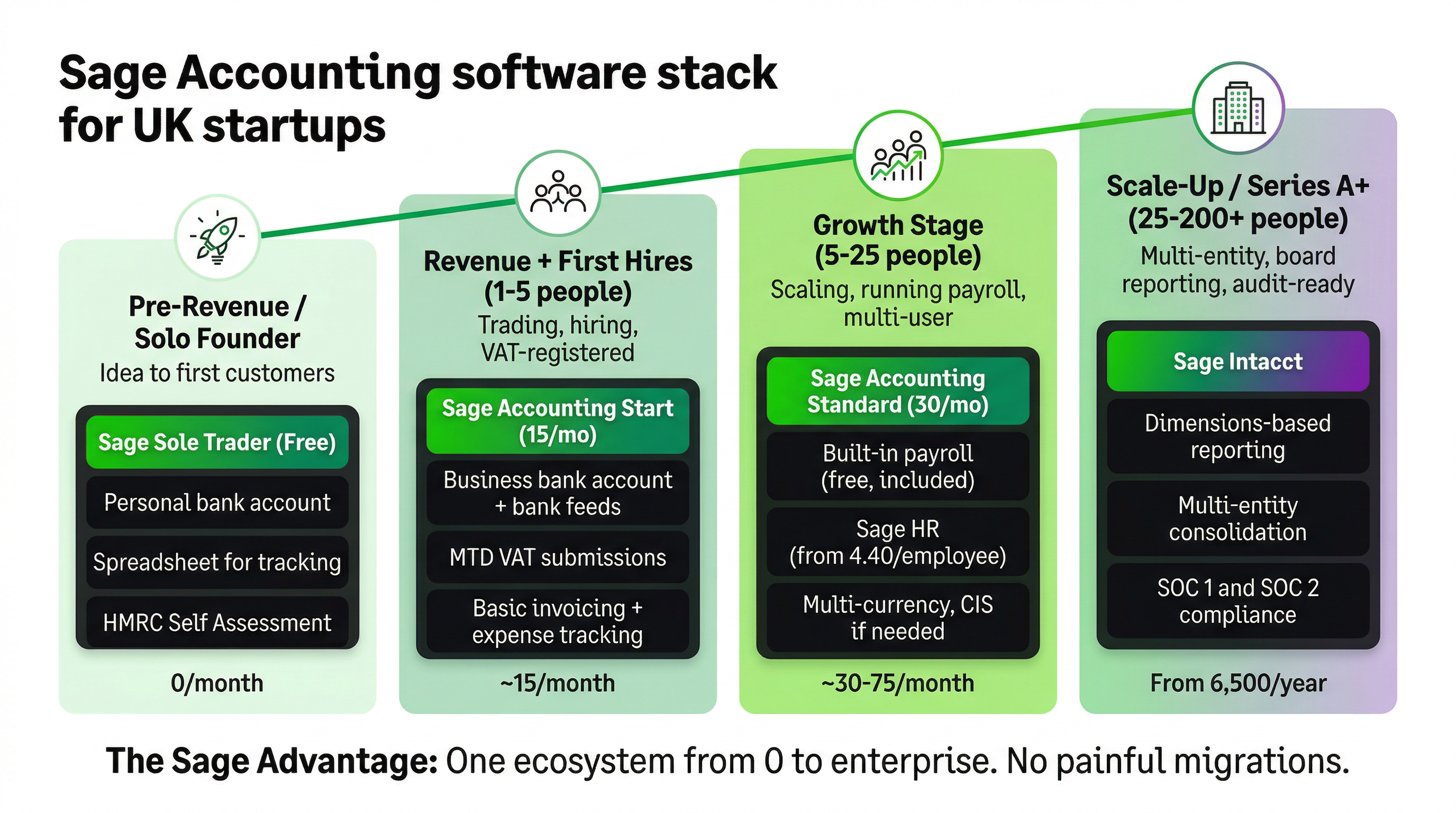
Sage's biggest advantage for UK startups is the breadth of its product range and the fact that you can move between plans without switching platforms or migrating data. The Sage pathway for a growing UK startup looks like this:
- Sage Sole Trader (Free): For the very early days of a sole trader business or freelancer. Covers basic income/expense tracking, MTD for ITSA compliance, and quarterly submissions. No invoicing on the free plan.
- Sage Accounting Start (£15-18/mo): The step up for new limited companies or sole traders who need professional invoicing, VAT returns, and bank feeds. One user, designed for simple businesses.
- Sage Accounting Standard (£30-39/mo): The sweet spot for startups with employees. Adds payroll (bundled, no per-employee charge up to a limit), CIS for construction startups, up to three users, and more advanced reporting.
- Sage Accounting Plus (£59/mo): For startups that have expanded internationally or need inventory management — multi-currency invoicing, budgets, unlimited users, and full inventory.
- Sage Intacct Essentials (from £6,500/year): The enterprise tier, appropriate for Series B+ companies with complex finance requirements, multiple legal entities, or institutional investor reporting needs.
The Sage Copilot AI assistant — included free on all plans — provides real-time financial insights, cash flow predictions, and compliance alerts. The MTD AI Agent is the UK's first agentic compliance tool, capable of reviewing your records and flagging potential issues before submission deadlines. These AI features are not just marketing; for a small startup team without a dedicated finance function, having an AI flag an uncategorised transaction or an approaching VAT deadline is genuinely useful.
The weakness of Sage for early-stage tech startups is its interface, which some users find less modern than Xero or QuickBooks. The R&D tax credit tracking also requires some manual setup — Sage does not have a dedicated R&D module at the SMB tier, though the project tracking feature can be configured to capture qualifying costs.
2. Xero
Xero has built an excellent reputation among UK startups, particularly in the tech sector, for its clean interface and extensive app ecosystem. The Xero App Store contains hundreds of integrations covering everything from e-commerce platforms to job management tools, making it highly flexible for businesses with specific workflow requirements.
Pricing: Xero Ignite starts at £16 per month (limited invoices and bills), Xero Grow at £37 per month (unlimited transactions), and Xero Comprehensive at £50 per month adding payroll, expenses, and projects. The Comprehensive plan is broadly comparable to Sage Accounting Standard in features but costs slightly more, and payroll is an add-on rather than bundled.
Xero is particularly strong for startups that need Shopify, Stripe, or HubSpot integrations, as these are mature and well-maintained. The Xero Analytics tool provides cash flow forecasting and "short-term cash flow" projections that are useful for managing runway. For tech startups burning through a seed round, knowing your cash position eight weeks out is genuinely valuable.
The main limitation is that Xero's UK payroll (included in Comprehensive, add-on below) has historically been less feature-rich than Sage's payroll. Auto-enrolment is supported, but some users report that configuring pension schemes requires more manual effort in Xero than in Sage.
3. QuickBooks
QuickBooks has a large UK user base and is well-supported by UK accountants. The Simple Start plan at £16 per month covers the basics for a new limited company, and the Essentials plan at £33 per month adds multi-currency (on some invoice types), payroll, and bill management.
QuickBooks is strong on reporting — the range of pre-built reports and the ability to customise them is genuinely one of its best features. For a startup that needs detailed management account packs for investors, QuickBooks produces well-formatted P&L and balance sheet reports that require less manual adjustment than some competitors.
The cash flow forecast tool in QuickBooks Plus (£47 per month) is well-regarded. For startups managing to a runway model — tracking how many months of cash remain based on current burn — the cash flow projection tools are more sophisticated than those in Sage's SMB tier.
QuickBooks' weakness is the payment structure: payroll costs extra (£8 per month plus £2 per employee), and advanced reporting features are locked to the higher plans. A startup that needs payroll, good reporting, and multi-currency ends up at £47-plus per month before extras, making it comparable in total cost to Sage Accounting Plus.
4. FreeAgent
FreeAgent is a UK-built accounting tool with a loyal following among freelancers and micro-businesses. It handles self-assessment tax returns unusually well — the software literally shows you your tax liability in real time as you record transactions, which reduces the year-end shock that many self-employed founders experience.
Pricing ranges from approximately £19 per month for sole traders to £34 per month for limited companies. Crucially, FreeAgent is available free to NatWest, Royal Bank of Scotland, and Ulster Bank business banking customers — a genuine advantage for bootstrapped founders who bank with these institutions.
FreeAgent is less well-suited to startups that anticipate growth beyond around ten employees. Its payroll handles small teams adequately, but the reporting depth and multi-currency support are limited compared to Sage, Xero, or QuickBooks. It is an excellent choice for the early days, but plan for a migration when you scale significantly.
5. Wave
Wave is a free accounting platform aimed at very small businesses and freelancers. It has a functional invoicing system, basic expense tracking, and bank feeds. For a UK startup, however, Wave has significant limitations:
- No MTD VAT filing support
- No UK payroll
- No multi-currency
- Trustpilot rating of approximately 1.6 out of 5 at the time of writing
- Customer support largely limited to chatbot and community forums
Wave is free because it monetises through payment processing fees. For a UK startup that needs to be VAT registered, file MTD returns, and eventually hire employees, Wave is not a viable long-term solution. It might work for a pre-revenue startup tracking basic expenses before VAT registration, but the transition costs when you outgrow it are significant. We would generally recommend starting on Sage Sole Trader (also free) instead — it is MTD-approved and has a clear upgrade path within the same ecosystem.
6. Zoho Books
Zoho Books is part of the Zoho suite of business software, which includes CRM, HR, project management, and helpdesk tools. If your startup is already using Zoho CRM or Zoho Projects, the accounting integration is seamless and genuinely adds value. Standalone, Zoho Books starts from around £12 per month and offers competitive features including MTD VAT filing, multi-currency, and project tracking.
The key caveat for UK startups: Zoho Books' MTD for ITSA compliance was listed as "in development" at the time of writing. For sole trader founders who will need MTD for ITSA compliance from April 2026, this is a meaningful gap. UK phone support is also less readily available than with Sage.
For a startup that is all-in on the Zoho ecosystem, Zoho Books makes compelling sense. For one adopting accounting software in isolation, the MTD ITSA uncertainty and relatively thin UK accountant integration (compared to Sage or Xero) are reasons for caution.
7. Crunch
Crunch takes a different approach from the others: it bundles accounting software with an accountant service, providing a hybrid software-plus-human offering. Plans start from £25.50 per month and include the software plus access to accounting professionals who can help with your accounts, corporation tax return, and Companies House filing.
For startups that want their accounting handled rather than doing it themselves, Crunch is worth considering. You pay more than for software-only, but potentially less than a traditional accountant. The limitation is flexibility — you are tied to Crunch's in-house team rather than being able to choose your own accountant.
Full Comparison: UK Startup Accounting Software 2026
| Platform | Starting Price | MTD ITSA | Payroll | Multi-Currency | Scalability | UK Support |
|---|---|---|---|---|---|---|
| Sage | Free (Sole Trader) | Yes — first MTD agent | Bundled on Standard+ | Yes (Plus+) | Free → Intacct enterprise | Phone on all paid plans |
| Xero | £16/mo (Ignite) | Yes | Add-on cost | Yes (Grow+) | Good — stops before enterprise | Online / community |
| QuickBooks | £10/mo | Yes | Add-on (£8+£2/emp) | Yes (Essentials+) | Good — stops before enterprise | Phone and chat |
| FreeAgent | £19-34/mo (free for NatWest) | Yes | Included | Limited | Best for up to ~10 employees | Online |
| Wave | Free | No | No UK payroll | No | Very limited | Chatbot only |
| Zoho Books | ~£12/mo | MTD VAT yes; ITSA in dev | Via Zoho Payroll | Yes | Good (within Zoho suite) | Limited UK hours |
| Crunch | From £25.50/mo | Yes | Via accountant service | Limited | Accountant-led — less self-serve | Dedicated accountant |
Startup-Specific Accounting Scenarios
Tracking a Seed Investment Round
When you raise a seed round, the money hitting your bank account needs to be recorded correctly. In accounting terms, the investment creates share capital and share premium on your balance sheet — it does not appear on your profit and loss account. All of the platforms covered here can handle this with the correct journal entries, but the ease of doing so varies.
In Sage Accounting, you record the share issuance by crediting the Share Capital and Share Premium accounts on the balance sheet and debiting your bank account. Sage's chart of accounts includes these accounts by default, making the entry straightforward. The accounts then show the correct equity structure, which matters when investors review your balance sheet or when you prepare your annual statutory accounts.
R&D Tax Credit Preparation
The UK's R&D tax credit scheme (now operating under the unified RDEC scheme from April 2024) allows companies to claim additional tax relief on qualifying research and development expenditure. Qualifying costs typically include staff costs directly engaged in R&D, subcontractor costs, software costs, and consumables.
None of the platforms in this comparison have a dedicated R&D module at the SMB tier. However, Sage Accounting Standard and Plus support project tracking that can be configured to capture costs by project type. By creating a project for "R&D activities" and assigning qualifying transactions to it, you generate a report at year end that your accountant can use to prepare the R&D claim. This is not fully automated, but it is significantly better than manually trawling through bank statements.
Companies House Filing Requirements
All UK limited companies must file annual accounts with Companies House. The statutory accounts must be in a format that meets Companies House requirements — which differs from your management accounts. Most accounting platforms support the production of accounts to the required standard (abbreviated accounts for micro-entities, or full accounts for larger companies), either within the software or via export to your accountant's practice software.
Sage integrates with Sage for Accountants (the practice software used by many UK accounting firms), creating a seamless handoff between your management records and the statutory accounts preparation process. This is a meaningful advantage if your accountant already uses Sage practice software — data does not need to be rekeyed.
Making the Right Choice for Your Startup Stage
Rather than a single recommendation, the right choice depends heavily on your current stage and trajectory:
- Pre-revenue sole trader: Start with Sage Sole Trader free or FreeAgent (free via NatWest). Both handle MTD for ITSA — the key compliance requirement from 2026 onwards.
- Early limited company, bootstrapped: Sage Accounting Start at £15-18 per month is the best value entry point for a registered limited company. Covers invoicing, VAT, and bank feeds with a clear upgrade path.
- Seed-funded startup with 2-10 employees: Sage Accounting Standard at £30-39 per month provides payroll (bundled), more users, and the CIS support some startups in construction or property need. Xero Comprehensive at £50 per month is the main alternative.
- Growing startup, 10-50 employees, international customers: Sage Accounting Plus at £59 per month adds multi-currency and unlimited users. Xero is a strong competitor here, particularly if you rely heavily on app integrations.
- Series B+ with complex finance requirements: Sage Intacct from £6,500 per year offers true multi-entity consolidation, dimensional reporting, and the audit-grade financial management that institutional investors and auditors expect.
Our Verdict by Startup Type
Best for Bootstrapped Founders: Sage Sole Trader (Free) or FreeAgent
When cash is tight and your needs are simple, start free. Sage Sole Trader handles MTD compliance and basic bookkeeping at no cost, with a clear path to paid Sage plans as you grow. FreeAgent is free for NatWest customers and excellent for self-assessment tax visibility.
- Zero upfront cost
- MTD-compliant from day one
- Upgrade available without data migration
Best for Funded Startups with Employees: Sage Accounting Standard
The bundled payroll (no per-employee charge up to threshold), three-user access, and strong HMRC integration make Sage Standard the best all-in price for a startup that has just hired its first employees. The MTD AI Agent and Sage Copilot reduce the compliance burden on non-finance founders.
- Payroll included — saves £8-20/mo vs Xero or QuickBooks
- UK phone support for deadline queries
- AI-assisted categorisation and compliance alerts
- 40+ years UK market presence — accountant familiarity
Best for Integration-Heavy Startups: Xero
If your startup relies on specific third-party tools — Stripe, HubSpot, Shopify, Gusto — and those integrations are mature in the Xero ecosystem, the extra monthly cost may be justified. Xero's app store depth is genuinely wider than Sage's at the SMB tier.
- Strongest app ecosystem of any UK accounting platform
- Clean, modern interface that non-accountants find intuitive
- Good cash flow forecasting tools for runway management
Best for Long-Term Scale: Sage (Full Pathway)
No other accounting platform in the UK market offers a clear, migration-free upgrade path from a free sole trader tool all the way to enterprise-grade ERP. For a startup that is serious about building a scalable business, starting on Sage means your accounting infrastructure can grow with you for the next decade without a disruptive platform switch.
- Sage Sole Trader → Accounting Start → Standard → Plus → Intacct
- No data migration at each stage
- Same UK-based support team throughout the journey
- Intacct handles multi-entity, multi-currency, and audit-grade reporting
Whatever you choose, the most important thing is to start using dedicated accounting software from day one — not a spreadsheet. The habits of good record-keeping that you establish in year one will serve you in every subsequent year, and the cost of switching platforms mid-growth is always higher than the cost of choosing the right one at the start.